How Often Should I Talk to My Baby?
A Parent’s Guide to Talking, Bonding, and Language Development
A few weeks ago, I was sitting on a blanket on the floor of my friend’s apartment, taking turns making sounds with her 5 month old. My friend was washing dishes and sharing how completely exhausted she felt.
“Do I really need to talk to him all day long?”
If this question popped into her head, I thought other parents must feel or wonder the same thing.
So, if you’ve ever wondered:
“Am I talking to my baby enough?”
“What should I say next?”
“Do I really need to talk all day?"
You’re not alone, and this blog post is for you!
The good news is that you don’t have to talk constantly to support your baby’s speech and language development.
Research has shown that the quality of interactions has a greater impact on infant language development than the pure quantity of words heard.
So if you’re exhausted and sleep deprived but desperately want to support your child’s development, here are some tips to make talking to your little one feel more manageable:
1) Narrate and Talk During Everyday Routines
When you’re tired, you don’t need another task on your parenting checklist. Figuring out what to say to your baby and when to say it might feel daunting. So, try talking about what you’re doing as you’re doing it.
For example, you might narrate what you’re doing while dressing your baby (“We need a new onesie. Let’s pick the blue one. One leg in…now the other!”) or while making your breakfast (“Yum, yogurt…we need a bowl…let’s add banana”).
These little conversations may seem simple, but they give your baby repeated opportunities to hear the sounds, rhythms, and patterns of language while giving you a clear topic to talk about.
2) Take breaks from talking to focus on reciprocity (turn-taking) using imitation of sounds and facial expressions.
Back-and-forth exchanges teach your baby something incredibly important: communication is a two-way street.
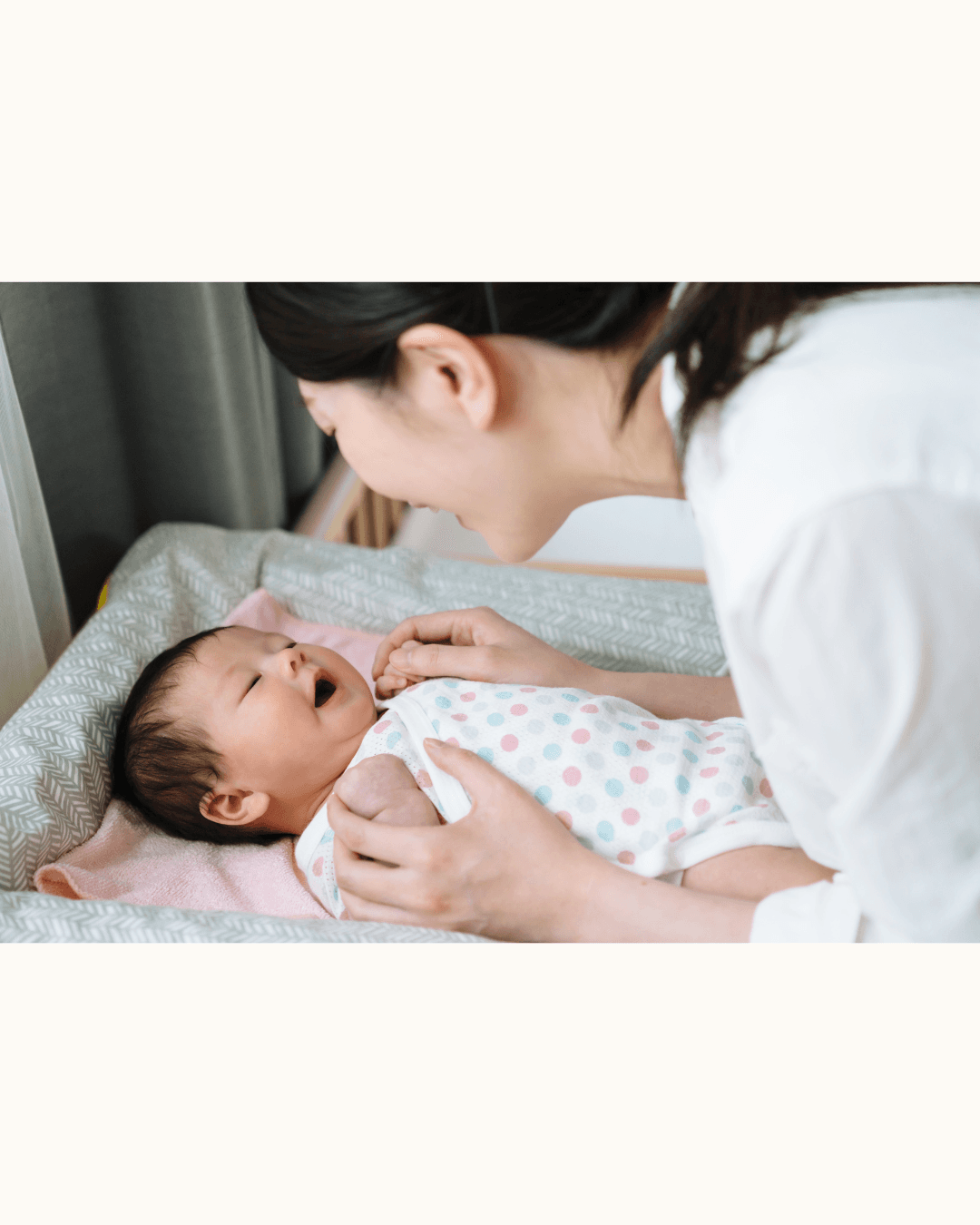
For example, if your baby makes a sound or facial expression, you can respond by imitating (making the same sound back), adding to the sound, or mirroring the facial expression.
When your baby smiles, you smile back. When they say bababa, you say bababa. This simple “serve and return” interaction helps build the foundations of communication and language.
3) Use someone else’s words!
Reading stories and singing songs are beneficial for even the littlest ones.
Try holding or propping up your baby so they can see your face. Then read a short story or just label the pictures you see on the page (“I see a cat. Hi Cat. Meooow”).
Sing your favorite childhood songs or use songs with gestures to incorporate actions and movement (“If You’re Happy and You Know It”).
Make up your own lyrics to common tunes! One of my friends made up a diaper change song to the tune of Frere Jacques to make diaper changes more entertaining for her little one and more bearable for her!
4) Add in signs!
Did you know that infants can often produce signs before they produce words?
While babies often say their first word around 12 months, they may begin signing around 8 months if their caregivers have been modeling signs. This is because hand and motor control develop before speech.
Research has shown that sign language does not delay speech but actually supports early language development!
Use signs in daily routines to label basic actions, wants, and needs (“eat” “milk” “wash” “music”). Match the sign to the item or activity so your baby understands what the gesture means. This will be most beneficial starting at 4-6 months of age.
Signs can be taught with or without verbal language although pairing the verbal word with the sign can help babies connect the two concepts.
5) Support physical development with tummy time, gentle stretches and movements, and sitting practice (depending on your baby’s age).
If you need a break from talking, try some gentle movement to support your baby’s physical development.
Tummy time helps to strengthen neck, shoulder, and core muscles. Gentle movements like bicycles can help to build muscle and coordinate natural movements. Work on tracking and reaching by holding a toy in your baby’s line of sight and slowly moving it (this is also great prep for rolling).
Remember…
Parenting isn’t a competition, and your baby doesn’t need you to say a perfect number of words daily.
Instead, focus on connection, responsiveness, and repetition. Use simple language.
- Talk and narrate when it feels natural, like during daily routines
- Imitate sounds and facial expressions to build reciprocity
- Read and sing songs together
- Introduce signs
- Support physical development with gentle movement
If you’re tired, busy, or just enjoying a quiet cuddle, that’s okay! Your baby benefits from hearing language over the course of many interactions, not from having every waking moment filled with talking.
Too tired to think of something new? Just repeat! Remember everything is new to your baby.
Still have questions?
Speech on the Slope provides speech and language evaluations and therapy for children and families throughout South and Northwest Brooklyn.
If you have questions about your child's communication development, we're happy to help you determine whether their skills are on track and discuss next steps.
📞 📩 Contact us to schedule a free consultation!
Have questions about your child's speech or language development?
Get in Touch