How do I Help my Kids Become More Independent?
Imagine you’re leaving work for the day. You know you need to stop at the market on the way home to pick up some groceries for dinner (goal). You go to the same market every day, so you can picture it in your head. You start walking there (initiation). You make a mental list of the things you need and maybe even picture yourself walking through the aisles and picking up those items (planning, working memory). The store is out of bananas, so you choose a different fruit (emotional control, flexibility). You think about how long this task will take and estimate what time you will get home (time management).
By the time you get home, you will have used many if not all of your executive functioning skills!
Now, imagine you’re on vacation, maybe in a foreign country. You don’t know where the store is, so you can’t picture it. You don’t know the directions to walk there. You are not sure what items to get or how flexible you will need to be if those items are not in stock. You may begin to feel some emotions: maybe stress, anxiety, or fear. Maybe some excitement at learning something new and conquering a new task?
Children may feel these same emotions when learning a new task, so it helps if we can provide them with a roadmap!
What are executive functions?
Executive functions are like the “management centers” of our brains. They develop over time (all the way into adulthood!) and support our abilities to create and meet goals.
Children who have difficulty with executive functions may:
- need several reminders to get started on a task
- be unsure of how to set up and follow through on their play idea
- have difficulty regulating emotions, like frustration, when a task feels challenging
- need several repetitions or reminders of directions before they complete a task, especially if it has multiple steps
- have difficulty problem solving
How do they develop?
Executive functions develop over time! However, there are some processes and activities we can use to support a child’s independence and growth.
Here are a few executive function milestones and some ideas that can be incorporated into daily routines to support their development:
0-24 months
As a baby, your child is not independent! They need you to help regulate their emotions, interpret and fulfill their needs, and plan their routines (e.g. feeding times, nap times).
- Playing games like “peek-a-boo” can help your child build pictures of familiar objects in their brains and learn that these objects don’t have to be in their sight to still exist (object permanence). This is helpful as they grow —> think “go find your shoes” when the shoes are in another room.
2 years old
At 2, your child can begin to follow 2-step directions and learn some independence with simple tasks.
- Practice and model language to ask for help: “Help me!” Or “I need help”
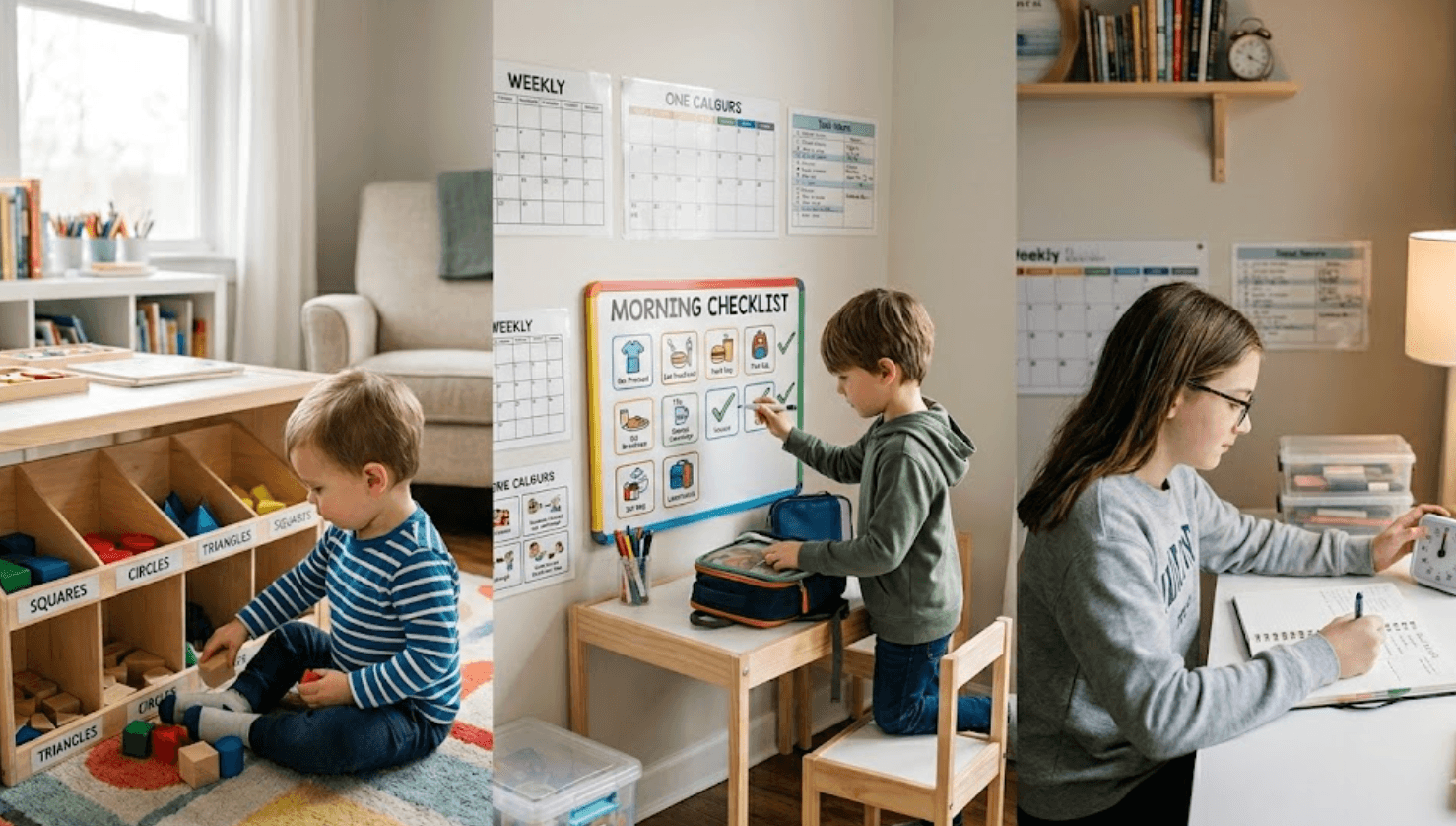
- Assign simple tasks (think Montessori): pouring water, cleaning surfaces, supervised food prep, getting dressed
- Create a visual schedule or visuals of steps in routines (e.g. getting dressed) to help your child learn them
- Practice and model language to improve frustration tolerance: “Our tower fell down! Crash! Let’s build it again!”
3-4 years old
At 3, you may see more problem solving skills start to emerge.
- Encourage your child to complete simple routines themselves using the previous visuals: “This is what you look like when you are dressed/ready. How can we match this picture? What should we do first?”
- Expand on language to ask for help: “I need help with my shoes”
- Talk through and praise the process: “You put on your shirt. You put on your pants. I saw you tried to pull on your socks. Thank you for trying. Let me show you a trick.”
- Talk through your child’s emotions and those of others: “Sabrina was playing with that car. You took the car. Now she is crying. She might be feeling sad. Let’s ask first, ‘can I have the car?’”
Helpful reminders:
- Show your child the “goal” (in Sarah Ward terms, the “done”) before you start the task
- Give them time to fail and try again. First time getting dressed by themselves? Maybe try on a weekend when you have more time.
- Be kind and patient with yourself and your child. This is a learning process for everyone!
Interested in learning more about supporting independence or how working with an SLP could help? Speech on the Slope supports children and families throughout South and Northwest Brooklyn, helping kids build communication skills and confidence in everyday life.
Have questions about your child's speech or language development?
Get in Touch