Boost Your Child’s Speech at Home: 10 Simple, Fun Ways to Support Their Language Development
As a parent, you might wonder if you’re doing enough to help your child’s speech and language grow. The good news? You can nurture your child’s language skills right at home, in a natural and meaningful way. With small, intentional activities woven into your daily routine, you can supercharge your child’s speech development right from the comfort of home.
Children develop speech and language skills at different rates, but there are lots of ways parents can support this growth at home. Research shows that consistent, meaningful interactions with children, through talking, reading, and playing, have a huge impact on their communication skills. The following strategies are practical, easy to implement, and can even be fun for the whole family!
1. Talk With Your Child, Not Just At Them
Engage in real conversations, even with toddlers. Instead of only giving directions, add commentary, expand on what they say, and ask open-ended questions:
- “Wow! Look at that tall, blue tower!”
- “Look at all of the animals! What animals do you see? What are they doing?”
Tip: Wait for your child to respond before speaking again. This encourages turn-taking and also gives them time to formulate a response.
2. Read Together Every Day
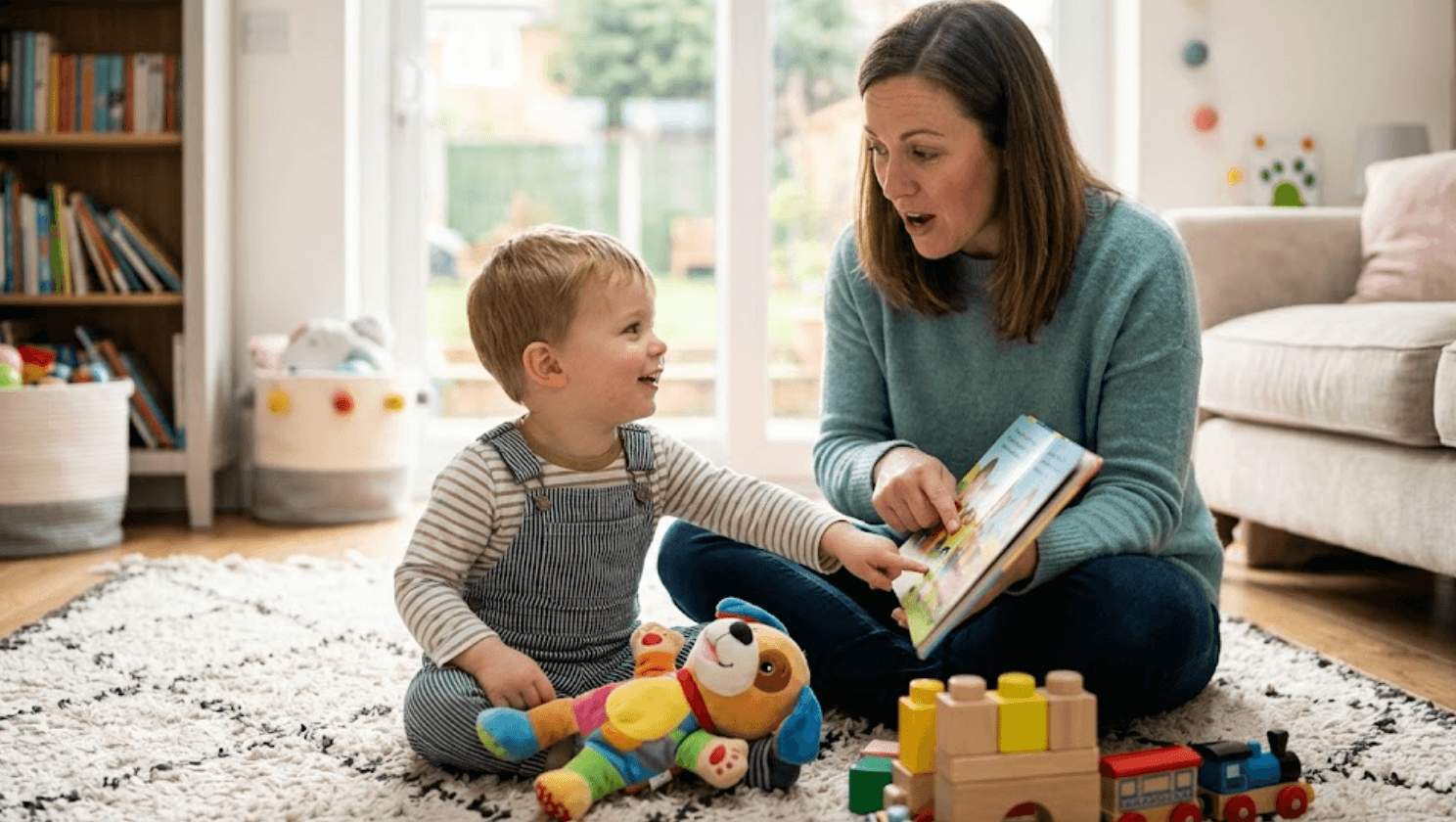
Reading aloud exposes children to new vocabulary, sentence structures, and story concepts. Make it interactive:
- Ask your child to point to pictures, turn the page, or track the words with their finger as you read.
- Pause and let them finish sentences or predict what happens next.
- Use expressive voices to model character emotions.
Tip: Choose age-appropriate books and repeat favorites. Kids love repetition and it reinforces learning.
3. Model Correct Speech Gently
When your child mispronounces a word, repeat it correctly in your response, instead of critiquing.
- Child: “I goed to the park.”
- Parent: “Oh, you went to the park? That sounds fun!”
Tip: This helps them hear the correct form in context without pressure or frustration.
4. Use Play to Encourage Language
Play is a natural way to spark conversation:
- Pretend play: Kitchen sets, doctor kits, or action figures encourage role-playing and dialogue.
- Board games: Simple games that require taking turns help with vocabulary and social language.
- Outdoor play: Talk about what you see, hear, and do together–trees, birds, traffic sounds.
5. Incorporate Songs, Rhymes, and Chants
Songs and rhymes help children hear patterns in language and practice pronunciation:
- Sing familiar nursery rhymes and emphasize repetitive sounds.
- Clap, stomp, or move along with the rhythm to make it engaging.
- Try tongue twisters for older children to work on articulation in a playful way.
6. Expand on What Your Child Says
Take your child’s words and add a little more detail to help them learn to express complete thoughts:
- Child: “Dog run.”
- Parent: “Yes! The brown dog is running fast in the yard.”
Tip: This introduces new vocabulary and models grammar naturally.
7. Limit Screen Time and Encourage Conversation
Passive screen time doesn’t help speech development as much as interaction. Replace some TV or tablet time with activities that spark talking:
- Family board games
- Cooking together
- Outdoor exploration
- Telling stories
8. Create a “Speech-Friendly” Environment
Supporting your child’s speech development at home doesn’t have to be overwhelming:
- Use clear, slow speech when talking with your child.
- Label objects around the house (e.g., “refrigerator,” “toothbrush”) to build vocabulary.
- Keep books, puzzles, and toys accessible to encourage self-directed speech opportunities.
9. Practice Sounds and Words Strategically
If your child is working on specific sounds (like “s” or “r”), turn practice into a game:
- Use favorite toys to practice target words.
- Play “I spy” with objects containing the target sound.
- Make silly sentences together with the sound.
Tip: Keep practice short and fun—5 minutes a few times a day is more effective than long, pressured sessions.
10. Celebrate Communication, Not Perfection
Encourage every attempt at speech. Praise efforts to communicate, whether it’s a word, gesture, or sentence. Positive reinforcement keeps children motivated and confident in their speech development journey.
By weaving conversation, reading, play, and modeling into everyday routines, you’re giving your child the tools they need to grow into a confident communicator. Remember, consistency matters more than perfection, and celebrating every step of progress will make learning fun for both of you!
Interested in learning more about supporting independence or how working with an SLP could help? Speech on the Slope supports children and families throughout South and Northwest Brooklyn, helping kids build communication skills and confidence in everyday life.
Have questions about your child's speech or language development?
Get in Touch